Better than Skittles
Tue Aug 25 2015 07:00:00 GMT-0500 (Central Daylight Time)
Do you know Morse code?
Wish I did. I’ve never put in the effort, but it’d be wicked handy. The gui on the things I build for myself would be a lot easier to code.
ASCII perhaps?
I always forget where to start the alphabet. I’m sure it’d stick if I did more firmware work. I also still mess up Commodore ASCII and ANSI ASCII, so punctuation is likely forever scrambled. I still sometimes use shift+2 for double quote.
How about resistor color codes?
Now you’re talking. After a seemingly interminable beating my mind did finally ossify around the simple table of numbers and colors that rules vintage electronics. I’ve used this to every advantage I’ve been able. Once you know an alternate representation of things the world takes on a different dimension. Knowing the resistor color code makes flags in particular a new experience. The temptation is to put the code in service elsewhere in your world where it’s strengths are valuable. The reality is that I’ll have to put a lot of energy into making this practice efficient, and that kind of ruins the point.
The resistor color code is nearing a century of age now. Care went in to it’s creation, as with most standards, but there are some more modern difficulties that complicate it’s widespread adoption as a general numeric code.
Start with black. Not a good place for zero. Many substrates are black already, especially after sufficient heating. A charred resistor may say that it’s resistance is zero . . . zero, times ten to the power of zero, but it’s usually closer to infinite. I’ll let the pedantic reflect on that assertion.
Brown is very close to black, sometimes deceptively. When heat attacks warm colors (heh) they tend to brown like a turkey, which complicates things. Also, have you ever seen a brown LED? Emissive brown is sort of a dull shade of orange/red. It’s a bit tricky to pull off without contrast or context, at least while avoiding ambiguity with it’s more saturated neighbors. This makes it ok on a flat panel TV when you’re obviously looking at trees and sky, but crummy when you want a three color LED to emit red, orange, brown, and yellow as distinct colors.
The bulk of the colors following are without serious issue. Let’s skip to the troublemakers at the end.
Grey? Eight is my favorite number too. Again we have a toasted white, and though a grey LED might be a bit easier to work around than brown it still has it’s issues.
Finally we have white at nine. If we are guaranteed to have a substrate that is neither black, nor white, nor brown, nor burnt, nor any other of the above colors, then we’ve avoided ambiguity. Due to white being a common substrate it’s a bit rare for marking media to have a ‘white’ color. Chalk, crayons, and paint (white out?) come to mind.
There are workarounds for some of these. Substrate colors like black and white could be outlined in their alternate for emphasis. Use of reflective substrates rather than emission helps. We also need a marking medium that can mark in all of the above colors. What a pain.
Despite all these disadvantages there are times when I find it useful to deploy the resistor color code as my marking of choice. Properly colored shrink wrap can be cut into bands to permanently number wire. There are products out there designed to treat to this, but those I’ve seen that are cheap are also poor fits for the task, i.e. clumsy with multi-digit numbers.
Often I don’t need to be able to relate a full decade of numeracy. Eight bits will get you to violet if you start at zero like a sane person, and that frees up grey and white allowing light colored substrates. That solves an awful lot of problems right there, and if you’re willing to work in octal you’re in luck.
Sometimes I have to mark something much smaller or more awkward than I could write a simple number on. In these cases it’s useful to be able to simply tag something with a color. Connector header pins and wires pulled from old ribbon cable are favorites. I’ve color coded my Bus Pirate pins in this manner, for example.
Enter the Sharpie. Now in more colors and sizes than ever, these permanent markers easily clean off of most solids with isopropyl alcohol. Long had I yearned for the mythical brown sharpie, thinking to myself that nobody would bother making a sharpie in brown. That would at least get me my number one, and I had a red one for two. Perhaps I could learn trinary? I have green and blue as well, but without those warm colors I’d be just making things up as I went along.
Then I saw this . . .
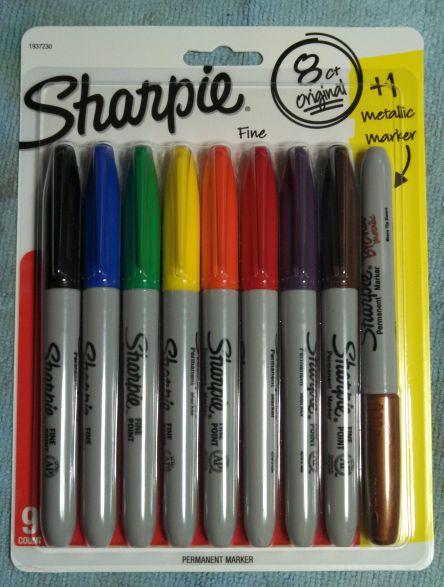
Available for a pittance at my local Wide Wide World of Walter. I looked online and found that the simplest way to find these is to search for ‘sharpie 8 count’.
Now I depart to see how useful these can be. I’ll try to visit back on occasion and add ideas as they arrive. If you have any ideas for me then please do send me an email and if they’re sane I’ll add them in. I intend to leave comments off until enough people badger me and make it worth fighting the spam.
Edit (2020AUG26): Still haven't used these in anger except to color code my resistor drawers. They will likely prove useful when the time comes to organize the house ethernet wiring. In encouraging others to pick up the resistor color code the Greek flag has proven childishly comic.