JFETs Don't Leak
Mon Jun 12 2023 22:40:21 GMT-0500 (Central Daylight Time)
Ok, to be fair JFETs do leak, just not very much. Also, they leak more with temperature, but all diodes do. Did you know JFETs are diodes?
Disclaimer: All prices are from time of writing. If you're reading this in the future, good luck!
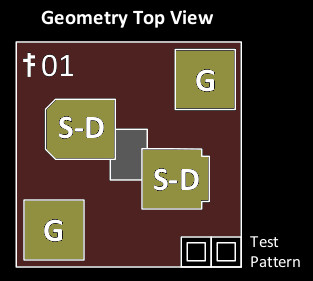 Here's a picture of the process die of a JFET as an example. In an N channel JFET:
- The gate is made of P doped silicon, colored dark red.
- The channel is N doped silicon, colored grey.
- The pads with the letters correspond to JFET terminals, colored gold. Bond wires connect these pads at one end and the lead frame pins at the other.
Note the pair of pads for the gate and the interchangeablity of the source and drain. Looks like a JFET, smells like a JFET. Still, there's a PN junction there between the gate and the source/drain. It's a diode junction just as much as any old two terminal diode, and despite the unintended nature of this arrangement it's perfectly serviceable.
The ratings must be respected of course, but in the end you have a diode good for a few tens of mA, a few tens of Vf, and potentially extremely low reverse leakage.
Once upon a magical time, back in early October of 1980, the Royals were just about beat the snot out of the Yankees for the American League pennant.
In the electronics world, Burr Brown had just published an application bulletin in EDN on the misuse of the above mentioned JFET diode. Their aim was to preserve the super high input impedance in their DiFET® precision opamps but still provide input protection. The DiFET® is a 'dielectrically isolated FET' that was used in the front end differental pair of opamps like the OPA124 and allowed for typical input bias currents of +/- 350fA with a max of 1pA.
Time to Obsess Over a Single Number on a Datasheet #
Let us compare some diodes and get a feel for what leakage currents look like:
- Old germanium diodes like the 1N34 are legendary for leakage. Typical datasheet maximum leakage at 10V is 30μA, rising to 500μA at 50V.
- A modern 1N4148 signal diode has a datasheet room temperature reverse leakage of about 7nA at 30V, a worst case of 25nA.
- The FDH333 used in B&K's 2120 20MHz scope from the late 80s is listed as a max 3nA at it's full rated 125V, with it's fancier brother the FDH300 as max 1nA.
- The 2SK30A maximum gate leakage is listed in Toshiba's 1997 datasheet as 1nA at 30V.
- The Burr Brown app note's 2N4117A is 1000 times lower at 1pA max at 20V with a 'typical' of 200fA.
It's difficult to get apples to apples comparisons of the performance differences. JFETs aren't really characterised like a protection diode.
One thing that haunts all PN junctions is leakage scaling with temperature. It roughly doubles for every 10C rise, and this will be reflected in the specs for all the really good stuff down in the picoampere range.
At some point there was suitable desire in industry for ultra-low leakage diodes, so the PAD (Pico Amp Diode) series was created and is still sold by InterFET. They're available in rounded E3 steps (1, 2, 5) in three decades (x1, x10, or x100) of picoamperes. Just append your chosen rating after 'PAD' and check the package types as not all ratings are available in all packages. Prices hang around the $7US mark and range up to $20US for the good stuff. Oh, and you'll never guess how they're made . . .
For the SOT-23 package, it is up to the user to short the source and drain pins.
Time for the big reveal. Those PAD diodes use the same die as the InterFET 2N4117A. This is the very same example die I used in the beginning. I guess if it isn't broken you probably shouldn't fix it.
The utility of JFET and PAD protection diodes do have their limits. Another member of the DiFET® family was the legendary INA116, an instrumentation opamp with two guard pins per input and built in +/- 40V input protection. If you've never heard of instrumentation opamps before they're kind of like an opamp with opamps for claws. The main draw is that they usually have amazing specs and you can adjust their gain with a single resistor. These particular beasts were boasting typical input bias currents of +/- 3fA, with a max of +/- 25fA.
Let's take that in for a second. This part was available in the 1980s and was specified to allow, at room temperature, no more than about 500 electrons per second in or out of it's input terminals, and at 85C no more than about 4000.
These are about $25US each in single quantity from Mouser. Sometimes it does feel like we live in the future.
Devices like this have big datasheets. Getting the performance listed in the datasheet requires care and understanding the vagaries of working with extremely low currents. Some of the techniques used to characterize these devices are lovingly explained by the godfather of analog, Bob Pease, in his articles for Electronic Design called 'What's all this Teflon stuff anyhow?' and 'What's all this femtoampere stuff anyhow?'.
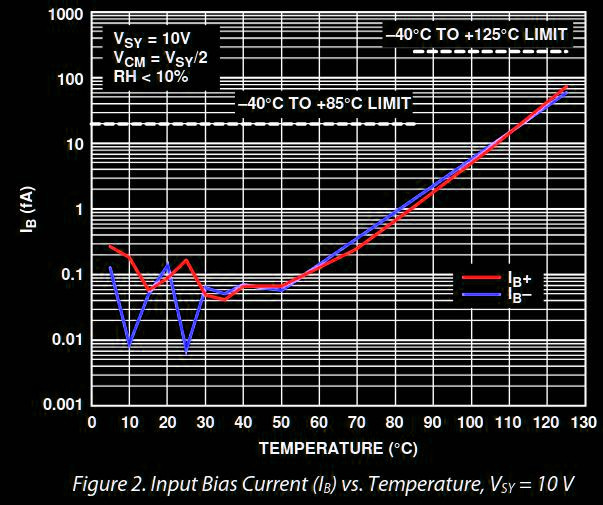 If you'd like to see how deep the rabbit hole goes then I'd recommend Analog Device's insane ADA4530. Their datasheets are always divine, and this one is no exception. This is often specified as a 20fA input bias current opamp, but that's over the entire -40C to 85C range at <50% relative humidity. At room temperature typical input bias currents of less than 1fA have been measured.
Most of us don't often use the word attoamps, but those AD folks are next level. One hundred attoamperes is about sixteen electrons per second.
One of these will set you back just over $33US.
I'll finish off with the smug first page graph from the datasheet.